


 Contact Platform Support
 Help Center
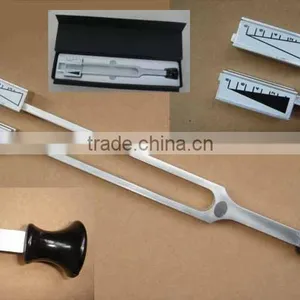
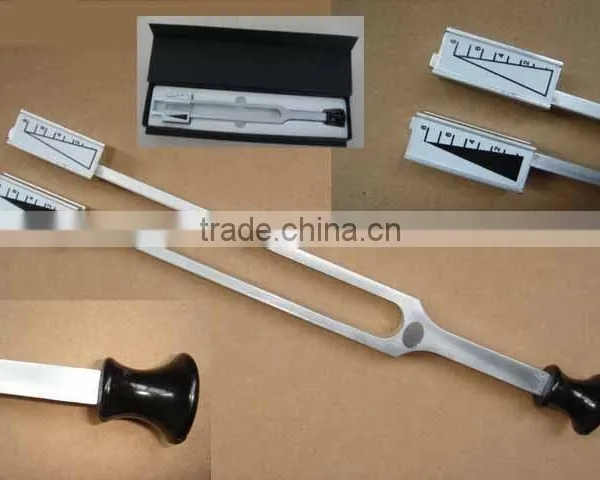
Neurological Testing, Neurology Tuning Fork


Related Products
-
 Aluminum Medical Healing Tuning Fork SetsUS$ 58 - 88MOQ: 100 Sets
 -
Medical Aluminum Tuning ForkUS$ 9.8 - 29.8MOQ: 1000 Pieces
-
Heart OM Tuning Forks TherapyUS$ 9.8 - 29.8MOQ: 100 Pieces
-
PITCH 480 HZ CROWN CHAKRA HARMONIC SPECTRUM TUNING FORK SETUS$ 9.2 - 11.5MOQ: 50 Boxes
-
Energy Wind Chime Tuner SetsUS$ 20 - 35MOQ: 10 Sets
A tuning fork is an in the form of a two-pronged with the formed from a U-shaped bar of metal (usually ). It at a specific constant when set vibrating by striking it against a surface or with an object, and emits a pure musical tone after waiting a moment to allow some high to die out. The pitch that a particular tuning fork generates depends on the length of the two prongs. Its main use is as a standard of pitch to tune other musical instruments.
The main reason for using the fork shape is that it produces a very , with most of the vibrational energy at the , and little at the (), as is the case with other resonators. The reason for this is that the frequency of the first overtone is about 52/22 = 25/4 = 6 1/4 times the fundamental (about 2 1/2 octaves above it). By comparison, the first overtone of a vibrating string is only one octave above the fundamental. So when the fork is struck, little of the energy goes into the overtone modes; they also die out correspondingly faster, leaving the fundamental. It is easier to tune other instruments with this pure tone.
Another reason for using the fork shape is that, when it vibrates in its principal mode, the handle vibrates up and down as the prongs move apart and together. There is a (point of no vibration) at the base of each prong. The handle motion is small, allowing the fork to be held by the handle without damping the vibration, but it allows the handle to transmit the vibration to a (like the hollow rectangular box often used), which amplifies the sound of the fork. Without the resonator (which may be as simple as a table top to which the handle is pressed), the sound is very faint. The reason for this is that the sound waves produced by each fork prong are 180° out of with the other, so at a distance from the fork they and largely cancel each other out. If a sound absorbing sheet is slid in between the prongs of a vibrating fork, reducing the waves reaching the ear from one prong, the volume heard will increase.
Currently, the most common tuning fork used by musicians sounds the note of , which has long been used as a standard tuning note by orchestras, it being the pitch of the violin's second string played open, the first string of the viola played open, and an octave above the first string of the cello, again played open. However, they are also commercially made to vibrate at frequencies corresponding to all musical pitches within the central octave of the piano, and other pitches
Zhuji Waverun Metalworks Factory was found in 2000, it committed to the production and research of fine, special and unique types of hardware. We have a long-term cooperative relationship with European and American customers and acquire a large share in a small market. Our company dedicates to provide excellent products to global customers.

Send Inquiry to This Supplier

You May Also Like
-
Medical Spatula White Wood Tongue DepressorUS$ 22 - 45MOQ: 1 Carton
-
Bipolar Coag,bipolar Cut Two Modes Cheap High Frequency Electrotome PriceNegotiableMOQ: 1 Set
-
Percussion HammersNegotiableMOQ: 1
-
Factory Body Massage Muscle Injury and Pain Relief Laser Surgical InstrumentsUS$ 350 - 680MOQ: 1 Set
-
Stamping Battery Box in Medical Equipment InstrumentUS$ 2.9 - 3.8MOQ: 500 Pieces
-
YDZ-30 Biological Storage Cryogenic Storage Tank Dewar Container Auto Tool With Low PriceUS$ 990 - 1,200MOQ: 1 Set
-
Max Waves Infrared Comb InstrumentsUS$ 40 - 41MOQ: 100 Pieces
-
Top in China Keling Medical X-RAY OBSERVATION LAMP (unifold)US$ 40 - 90MOQ: 10 Sets
-
High Quality Oem Service Medical Instrument AccessoriesUS$ 10 - 15MOQ: 100 Pieces
-
Stainless Steel Medical Surgical Instruments Manufacturer With Good PriceUS$ 0.1 - 5MOQ: 1000 Pieces