


 Contact Platform Support
 Help Center
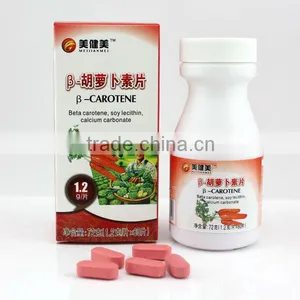
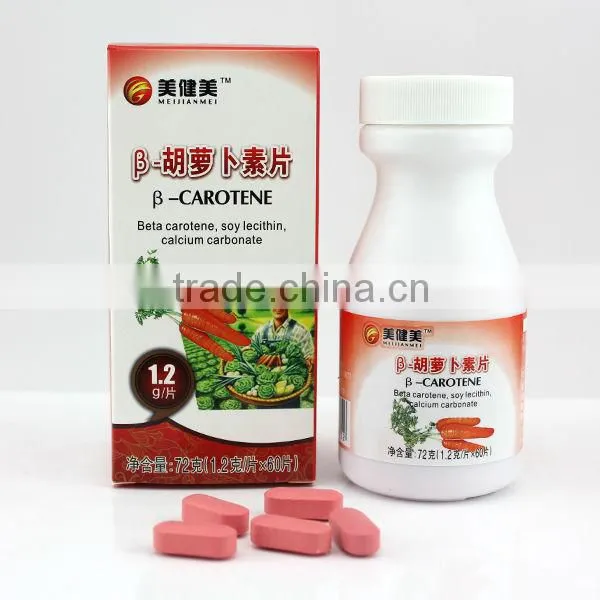
My Gym Beta-Carotene Tablet




Related Products
-
 My Gym Dietary Fibre TabletUS$ 21 - 28MOQ: 1 Box
 -
My Gym Collagen Protein Tablets/cheap and FineUS$ 18 - 25MOQ: 10 Boxes
-
My Gym Colostrum Basic Protein Tablet/cheap and FineUS$ 20 - 25MOQ: 10 Boxes
-
My Gym Lutein Ester Candy Tablet/cheap and FineUS$ 21 - 28MOQ: 10 Boxes
-
My Gym Acerola Cherry Tablet Candy/wholesale Price With a Good QualityUS$ 16 - 20MOQ: 10 Boxes
Specifications
Carotene is the substance in carrots, pumpkins and sweet potatoes that colors them orange and is the most common form of carotenβ-Carotene is a strongly colored red-orange pigment abundant in plants and fruits. It is an organic compound and chemically is classified as a hydrocarbon and specifically as a terpenoid (isoprenoid), reflecting its derivation from isoprene units. β-Carotene is biosynthesized from geranylgeranyl pyrophosphate. It is a member of the carotenes, which are tetraterpenes, synthesized biochemically from eight isoprene units and thus having 40 carbons. Among this general class of carotenes, β-carotene is distinguished by having beta-rings at both ends of the molecule. Absorption of β-carotene is enhanced if eaten with fats, as carotenes are fat soluble.
Carotene is the substance in carrots, pumpkins and sweet potatoes that colors them orange and is the most common form of carotene in plants. When used as a food coloring, it has the E number E160a. The structure was deduced by Karrer et al. in 1930. In nature, β-carotene is a precursor (inactive form) to vitamin A via the action of beta-carotene 15,15'-monooxygenase. Isolation of β-carotene from fruits abundant in carotenoids is commonly done using column chromatography. The separation of β-carotene from the mixture of other carotenoids is based on the polarity of a compound. β-Carotene is a non-polar compound, so it is separated with a non-polar solvent such as hexane. Being highly conjugated, it is deeply colored, and as a hydrocarbon lacking functional groups, it is very lipophilic.
Provitamin A activity
Plant carotenoids are the primary dietary source of provitamin A worldwide, with β-carotene as the most well-known provitamin A carotenoid. Others include α-carotene and β-cryptoxanthin. Carotenoid absorption is restricted to the duodenum of the small intestine and dependent on Class B scavenger receptor (SR-B1) membrane protein, which are also responsible for the absorption of vitamin E (α-tocopherol). One molecule of β-carotene can be cleaved by the intestinal enzyme β,β-carotene 15,15'-monooxygenase into two molecules of vitamin A.
Absorption efficiency is estimated to be between 9–22%. The absorption and conversion of carotenoids may depend on the form that the β-carotene is in (e.g., cooked vs. raw vegetables, or in a supplement), the intake of fats and oils at the same time, and the current stores of vitamin A and β-carotene in the body. Researchers list the following factors that determine the provitamin A activity of carotenoids:
- Species of carotene
- Molecular linkage
- Amount in the meal
- Matrix properties
- Effectors
- Nutrient status
- Genetics
- Host specificity
- Interactions between factors
Symmetric and asymmetric cleavage
In the molecule chain between the two cyclohexyl rings β-carotene cleaves either symmetrically or asymmetrically. Symmetric cleavage with the enzyme β,β-carotene-15,15'-dioxygenase requires the antioxidant α-tocopherol. This symmetric cleavage gives two equivalent retinal molecules and each retinal molecule further reacts to give retinol (vitamin A) and retinoic acid. β-Carotene is also asymmetrically cleaved into two asymmetric products. The product of asymmetric cleavage is β-apocarotenal (8',10',12'). Asymmetric cleavage reduces the level of retinoic acid significantly.
Conversion factors
Since 2001, the US Institute of Medicine uses retinol activity equivalents (RAE) for their Dietary Reference Intakes, defined as follows:
Retinol Activity Equivalents (RAEs)
1 µg RAE = 1 µg retinol
1 µg RAE = 2 µg all-trans-β-carotene from supplements
1 µg RAE = 12 µg of all-trans-β-carotene from food
1 µg RAE = 24 µg α-carotene or β-cryptoxanthin from food
RAE takes into account carotenoids' variable absorption and conversion to vitamin A by humans better than and replaces the older retinol equivalent (RE) (1 µg RE = 1 µg retinol, 6 µg β-carotene, or 12 µg α-carotene or β-cryptoxanthin). RE was developed 1967 by the United Nations/World Health Organization Food and Agriculture Organization (FAO/WHO).
Another older unit of vitamin A activity is the international unit (IU). Like RE, IU doesn't take into account carotenoids' variable absorption and conversion to vitamin A by humans as well as the more modern RAE. Unfortunately, food and supplement labels still generally use IU, but IU can be converted to the more useful RAE as follows:
International Units
1 µg RAE = 3.33 IU retinol
1 IU retinol = 0.3 μg RAE
1 IU β-carotene from supplements = 0.15 μg RAE
1 IU β-carotene from food = 0.05 μg RAE
1 IU α-carotene or β-cryptoxanthin from food = 0.025 μg RAE1
Sources in the diet
β-Carotene contributes to the orange color of many different fruits and vegetables. Vietnamese gac (Momordica cochinchinensis Spreng.) and crude palm oil are particularly rich sources, as are yellow and orange fruits, such as cantaloupe, mangoes and papayas, and orange root vegetables such as carrots and yams. The color of β-carotene is masked by chlorophyll in green leafy vegetables such as spinach, kale, sweet potato leaves, and sweet gourd leaves. Vietnamese gac and crude palm oil have the highest content of β-carotene of any known plant source, 10 times higher than carrots, for example. However, gac is quite rare and unknown outside its native region of Southeast Asia, and crude palm oil is typically processed to remove the carotenoids before sale to improve the color and clarity.
The average daily intake of β-carotene is in the range 2–7 mg, as estimated from a pooled analysis of 500,000 women living in the USA, Canada, and some European countries.
The U.S. Department of Agriculture lists the following 10 foods to have the highest β-carotene content per serving.
Item |
Grams per serving |
Serving size |
Milligrams β-carotene per serving |
Milligrams β-carotene per 100 g |
Carrot juice, canned |
236 |
1 cup |
22.0 |
9.3 |
Pumpkin, canned, without salt |
245 |
1 cup |
17.0 |
6.9 |
Sweet potato, cooked, baked in skin, without salt |
146 |
1 potato |
16.8 |
11.5 |
Sweet potato, cooked, boiled, without skin |
156 |
1 potato |
14.7 |
9.4 |
Spinach, frozen, chopped or leaf, cooked, boiled, drained, without salt |
190 |
1 cup |
13.8 |
7.2 |
Carrots, cooked, boiled, drained, without salt |
156 |
1 cup |
13.0 |
8.3 |
Spinach, canned, drained solids |
214 |
1 cup |
12.6 |
5.9 |
Sweet potato, canned, vacuum pack |
255 |
1 cup |
12.2 |
4.8 |
Carrots, frozen, cooked, boiled, drained, without salt |
146 |
1 cup |
12.0 |
8.2 |
Collards, frozen, chopped, cooked, boiled, drained, without salt |
170 |
1 cup |
11.6 |
6.8 |
Medical uses
β-Carotene has been used to treat various disorders such as erythropoietic protoporphyria. It has also been used to reduce the risk of breast cancer in women before menopause, and the risk of age-related macular degeneration (AMD).

Send Inquiry to This Supplier

You May Also Like
-
Garlic Oil, Garlic Oil Bulk, Garlic Oil ExtractionUS$ 4.5 - 5.5MOQ: 1000 Kilograms
-
Natural LingZhi From Own Farm;For Show; for Eat; for Tea;Ganoderma Lucidum;China Traditional Medical;US$ 389 - 990MOQ: 1 Piece
-
KneeUS$ 0.27 - 1.2MOQ: 500 Pieces
-
Electronic Pulse Massager With Magnetism Shoes AS979BUS$ 13 - 15MOQ: 500 Pieces
-
Gamma Butyrobetaine PowderUS$ 350 - 360MOQ: 25 Kilograms
-
Industrial Cowhide Protein Powder for FertilizerUS$ 1965 - 4699MOQ: 100 Tons
-
Remote Control Top Add Water Ultrasonic Humidifier/Ultrasonic Essential Oil Humidifie(SKYPE:lifuli123)US$ 24 - 26MOQ: 1000 Pieces
-
Nutritional Fortification Substance: Anhydrous Calcium AcetateNegotiableMOQ: 1 Metric Ton
-
Wholesale Safe and Healthy Soy Beans Powder Supplies Rich Various Nutrients and Proteins From ChinaUS$ 2 - 5MOQ: 20 Kilograms
-
Kosher Certified Creatine Monohydrate PowderUS$ 3200MOQ: 1 Metric Ton


