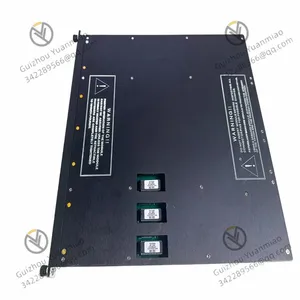
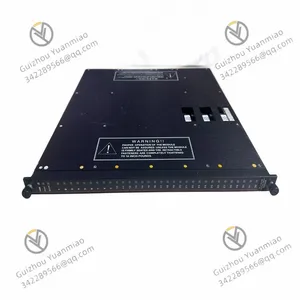
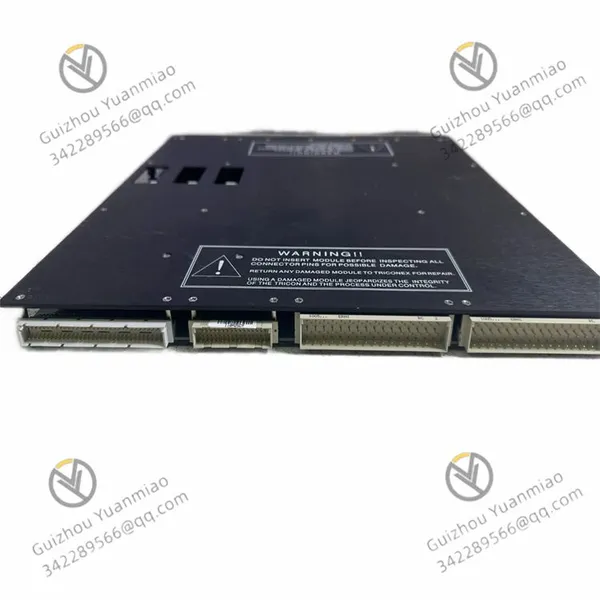
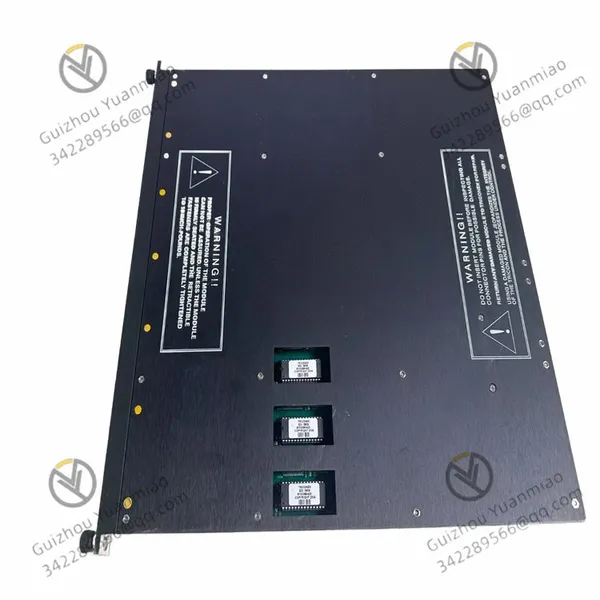
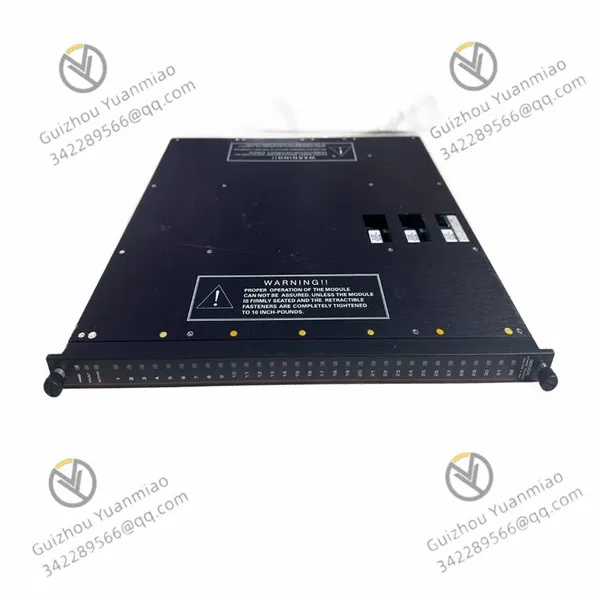
TRICONEX 3502E SIS Digital Input Module
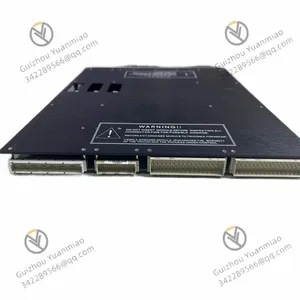
As a digital input module in the Triconex Safety Instrumented System (SIS), the working principle of TRICONEX 3502E is based on the Triple Modular Redundancy (TMR) architecture, designed around high-safety and high-reliability signal acquisition and processing. The specific process is as follows:
- Signal Access and Isolation
On-site Signal Reception
The module receives digital signals from industrial on-site equipment. These signals usually come from dry contacts (such as the on-off status of limit switches and pressure switches) or wet contacts (contact signals with external power supplies), and can also be compatible with specific level signals (such as TTL/CMOS).
A single module typically contains 32 independent input channels, with each channel corresponding to an on-site signal source, enabling high-density signal acquisition.
Electrical Isolation Protection
Each input signal is isolated from the internal circuit of the module through optical isolation or relay isolation technology, and the isolation voltage usually reaches more than 2500VAC.
Functions:
Prevent high voltage, surges, or grounding interference on the on-site side from entering the system side, protecting the internal circuit of the module and the controller;
Avoid signal interference between different channels to ensure signal independence.
2. Signal Conversion and PreprocessingAnalog-to-Digital Signal Conversion
The physical signals input on-site (such as voltage changes caused by the on-off of contacts) are converted into standard digital logic signals (0/1):
When the on-site contact is closed (or the voltage threshold is met), the output logic is "1" (indicating "signal present");
When the contact is open (or the voltage is lower than the threshold), the output logic is "0" (indicating "no signal").
Filtering and Anti-Interference Processing
The module has a built-in hardware filtering circuit, which can suppress interference such as jitter (like contact bouncing) and high-frequency noise of on-site signals to ensure signal stability.
The filtering time can be configured through software (usually at the millisecond level) to adapt to the response characteristics of different on-site equipment.

3. Signal Voting under TMR ArchitectureIndependent Processing of Triple Redundant Channels
Based on Triconex's TMR design, the module contains three completely independent signal processing channels (A, B, C) inside. Each input signal is sent to the three channels for parallel processing simultaneously:
2oo3 (Two-out-of-Three) Voting Mechanism
The processing results (logic 0/1) of the three channels for the same input signal are compared in real-time through a hardware voting circuit:
If the three results are consistent, the result is directly output (for example, if all are "1", it is judged as a valid signal);
If the result of one channel is inconsistent with the other two (such as A=0, B=1, C=1), the result of "majority consistency" (1) is taken as the final output, and the abnormal channel is marked as "fault" to trigger a diagnostic alarm;
If the three results are all inconsistent (such as A=0, B=1, C=0), the signal is judged as invalid, and a system-level fault response is triggered (such as forcing a safe state).
4. Data Transmission and Diagnostic FeedbackCommunication with Controllers
The valid signals after voting are transmitted to controllers (such as Tricon, Trident series) through the high-speed synchronous redundant bus of the Triconex system, for safety logic operations (such as interlock triggering, emergency shutdown commands).
The communication process supports redundant paths and CRC checks to ensure no loss or error in data transmission.
Real-time Diagnosis and Status Feedback
The module has a built-in self-diagnostic circuit to monitor the status of power supply voltage, isolation circuit, voting logic, communication links, etc., in real-time;
Detect abnormalities such as disconnection, short circuit, and overvoltage of input channels, and send fault information to the controller through the internal bus;
The LED indicators on the module panel display the overall health status (such as normal power supply and communication) and the input status of each channel (such as a lit light indicating "signal present") in real-time, facilitating on-site maintenance personnel to quickly locate problems.

5. Summary of Core Logic
The working principle of TRICONEX 3502E can be summarized as: "Isolated Acquisition → Independent Processing → Redundant Voting → Safe Transmission". Through the triple redundancy design and hardware-level voting mechanism, it ensures that even if part of the module's circuit fails, it can still output correct on-site signals, providing reliable input for the safety logic decision-making of the SIS system. It meets the safety integrity requirements of SIL3 level and is suitable for high-risk industrial scenarios such as chemical industry, oil and gas, and nuclear power.