


 Contact Platform Support
 Help Center
Mobile Steel Tool Cart for Multi-Station Assembly — One Tool Set Travels, Four Benches Stay




Product Spotlights



Related Products
-
 Multi-Functional Heavy-Duty Rolling Metal Tool Cart With Lockable Drawers and Pegboard for Industrial UseUS$ 60 - 120MOQ: 5 Combos
-
Durable Mobile Tool Cart With Spacious Storage and Adjustable Shelves for Garage and WorkshopUS$ 60 - 120MOQ: 5 Combos
-
Professional Large Capacity Compact Metal Tool Cart With Locking Drawers for Mechanic’s WorkshopUS$ 60 - 120MOQ: 5 Combos
-
Industrial Tool Cart With Lockable Drawers for Secure Tool Storage-Auto Repair and Industrial UseUS$ 60 - 120MOQ: 5 Combos
-
China Factory Wholesales Rolling Utility Tool Cart With Multiple Compartments for DIY Projects and Professional UseUS$ 60 - 120MOQ: 5 Combos
Mobile Steel Tool Cart for Multi-Station Assembly — One Tool Set Travels, Four Benches Stay
Short answer: if four benches share the same range of hand tools, you do not need four sets. Buy one mobile steel tool cart, load the full set on it, and let the cart move between benches. Four benches, one tool set, one purchase.
What Four Duplicate Tool Sets Actually Cost
The math looks harmless until someone adds it up.
Say a bench needs a spanner set, a socket set, hex keys, pliers, a torque wrench, a set of feeler gauges and a box of fasteners. None of that is exotic. Now multiply it by four, because four benches are doing the same work and each one was given its own kit.
Four torque wrenches. Four sets of gauges. Four sets of sockets in four different trays, none of them laid out the same way. The tools are the visible cost. The invisible costs arrive later:
Capital sitting in drawers. You bought the same spanner four times, and each one spends most of the day waiting.
Four calibration records. Every torque wrench and every gauge has to be tracked, checked and re-certified. One set is a job. Four sets is a job somebody forgets.
Four places to count. Year-end inventory on hand tools is nobody's favourite afternoon. It gets four times worse.
Four times the loss risk. Tools walk. When they do, the bench that lost the spanner stops and waits.
Layout lock-in. Move the benches, and the tool storage stays where it was bolted.
None of this shows up as a problem until the day one bench is idle because a socket set is missing, and the answer from the next bench is "we've got four of those."
| One set per bench | One mobile cart, four benches | |
|---|---|---|
| Sets bought | 4 | 1 |
| Money tied up in hand tools | 4× | 1× |
| Floor space | A storage unit at every bench | One cart footprint, moving |
| Calibration control | 4 sets to track and re-certify | 1 set, one log |
| If a tool breaks | That bench stops | Cart skips the bench, the others keep running |
| Stock counting | Four places to count | One place to count |
| Layout change | Storage stays where it was fixed | Cart follows the new layout |
How the Loop Actually Runs
The objection is always the same: "if the tools are on a cart, the tools are never where I am."
That is a scheduling problem, not a storage problem — and it has a simple answer. The cart has a route, and the route matches the work.
In practice, on a four-bench assembly cell, the pattern looks like this:
The cart starts at the bench with the longest operation. That is where it will be left standing for the biggest block of time.
It moves when a bench calls for it, not on a fixed clock. A card, a light, or simply a shout is enough — most shops use the simplest signal that works.
It parks with the casters braked. Four swivel casters with brakes mean the cart does not creep when someone leans on it during a heavy pull.
Tools go back on the pegboard, not in a drawer. The square-hole panel is the visual check: if a hook is empty at the end of a shift, everyone can see what is missing without opening anything.
The cart ends the shift at the same bench every day. Predictability is what stops it from being "someone else's cart" by the end of the week.
Two habits make the loop work better than any layout drawing. Keep the tool set on the cart complete — a cart with three-quarters of a set is worse than no cart, because people stop trusting it and start walking. And set a rule about what is allowed to live on the cart, so it does not turn into a travelling junk drawer.
What the Cart Is
Luoyang Hengna Office Furniture Co., Ltd. has been in steel furniture for nine years, working directly with the production facilities that build our range. The Hengna mobile steel tool cart for this kind of multi-station work — a 2026 build — is the four-drawer, single-door trolley:
Size: 1000 mm W × 500 mm D × 1000 mm H; 1350 mm overall with the hanging panel
Body: cold-rolled steel, electrostatic powder-coated finish
Drawers: four locking drawers for gauges, meters, small parts and consumables
Cabinet: single door with an adjustable shelf inside for bulkier items
Hanging panel: square-hole panel, standard, takes hooks, wrench racks and parts bins
Top: flat and load-bearing — a working surface at the bench, not a lid
Castors: four swivel castors with brakes; fixed or low-noise castors on request
Locking: cam lock on the cabinet and independent locks on the drawers
Delivery: welded and fully assembled
Certification: CE
Warranty: 1 year
Colour and branding: standard blue or blue-grey; other colours and silk-screen logos on volume orders
The flat top matters more than it sounds. On a multi-station loop, the cart is often the only horizontal surface at hand — it becomes the bench for a minute while someone checks a measurement or lays out a small subassembly.
What Belongs on the Cart, and What Stays Put
Making everything mobile is the classic mistake. This split works:
| Item | Where it goes | Why |
|---|---|---|
| Torque wrenches, calibrated gauges | On the cart, locked drawers | Shared, high value, one calibration log |
| Sockets, spanners, hex keys, pliers | On the cart, pegboard hooks | Used at every bench |
| Power tools | On the cart, lower shelf | Heavy, and shared between stations |
| Fasteners, tape, ties, small consumables | On the cart, parts bins | Every bench runs out of them |
| Fixtures and jigs for one operation | At the bench | Only that station uses them |
| Machine-specific tooling | At the machine | Not portable, not shared |
| Drawings, work instructions, route cards | At the bench | Station-specific paperwork |
| Gloves, glasses, personal safety gear | At the bench | Issued to a person, not a station |
The rule underneath: shared and portable goes on the cart; specific and fixed stays where it is.
When This Is the Wrong Setup
Being straight about the limits saves a bad purchase.
Benches far apart. If a bench is a two-minute walk away, the cart stops saving time and starts being a reason to wait. Roughly, a shared cart works when the benches are inside the same cell or bay.
Almost no tool overlap. If the four benches genuinely use four different tool sets, you are not sharing anything — buy the storage each one needs.
Specialist, single-station tooling. Sharing does not apply to a fixture that only fits one machine.
Calibration-controlled environments with per-station requirements. If your quality system requires a dedicated set per station, follow your system, not a storage idea.
Where the cart would be the only storage. One cart for a whole shop of twelve benches is not a loop, it is a bottleneck.
The setup that pays back fastest is a small cell — three to six benches, similar operations, shared hand tools — where a single person or a small team owns the loop and closes it at the end of each shift.
FAQ
What is the MOQ?
One unit for a sample. Multi-unit orders are quoted from the container up.
How does pricing work?
We do not publish prices — configuration and freight vary too much. Send the configuration and quantity and you have a quote within 24 hours.
FOB, CIF or something else?
All three, plus EXW. Give us the destination port and we quote the terms that suit you.
Warranty?
1 year.
After-sales?
Replacement parts shipped from our side. For plant and distributor accounts we agree a spares list up front — castors, lock sets, drawer slides, hooks — so one failure does not take the cart out of the loop.
Can we put our own brand on it?
Yes. Silk-screen logo, custom packaging, and custom manuals under your brand. Colour to your RAL reference, and unit numbering if you are equipping several cells.
Lead time?
Standard configuration 7–15 days. Custom colour or custom drawer layout 20–30 days.
How is it packed?
Moisture film, corner protectors, and hardware bagged separately. The cart ships welded, so no loose panels rub against each other in transit.
Does it need assembly on arrival?
No. Unload it, brake the casters, load it, and start the loop.
Can we change the drawer layout?
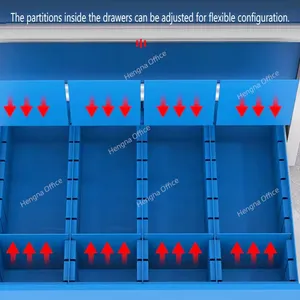
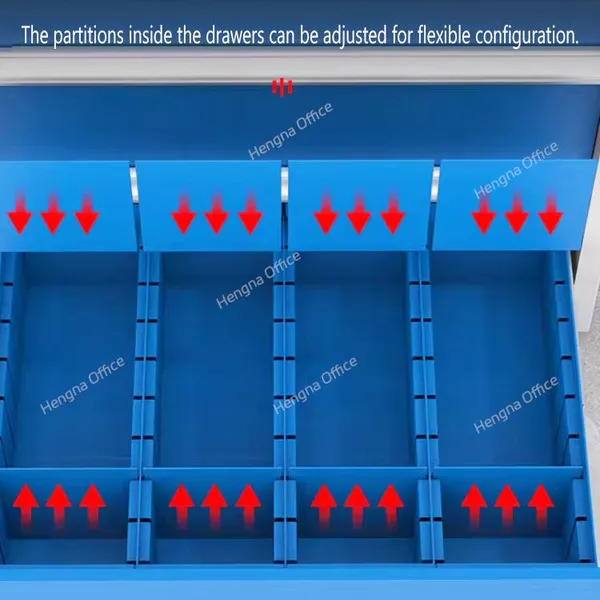
Yes — drawer count, drawer heights and internal dividers are configurable. Sending us your tool list is the quickest way to get a layout back.
Next Step
Tell us how many benches are in the cell, what the benches share, and how many carts you need. You get a quote within 24 hours — we supply assembly cells and workstations across Southeast Asia, the Middle East and West Africa.

Send Inquiry to This Supplier



You May Also Like
-
Heavy Duty Industrial Tool Cabinet BT40 With Pegboard Doors and Adjustable Shelves Blue/White/Gray-Orange for Workshop StorageUS$ 99 - 199MOQ: 2 Combos
-
Hengna Metal Tool Storage Cabinet With 4 Knife Boards and Perforated Doors for Factory Warehouse OrganizationUS$ 89 - 169MOQ: 2 Combos
-
Professional Tool Cabinet With Lockable Glass Doors 4 Adjustable Shelves BT50 Model H1800×W1000×D500mm Industrial GradeUS$ 109 - 159MOQ: 2 Combos
-
Industrial Tool Organizer Cabinet With Removable Shelves and Pegboard Design Heavy Duty Steel Construction for Workshop GarageUS$ 109 - 199MOQ: 2 Combos
-
Hengna BT50DJG22 Tool Cabinet With Single-Glazed Door H1800×W620×D500mm Blue/White/Dark Gray Color Options for Small GarageUS$ 66 - 99MOQ: 2 Combos
-
Durable Steel Tool Cabinet With Perforated Panels and Mesh Inserts 4 Knife Boards for Precision Tools Storage WorkshopUS$ 99 - 299MOQ: 2 Combos
-
Heavy Duty Tool Storage Cabinet With Adjustable Inner Plates 3 Shelves Lockable Design H1800×W760×D500mm for Industrial UseUS$ 99 - 159MOQ: 2 Combos
-
Industrial Metal Tool Cabinet With Ventilated Perforated Doors Multiple Color Choices 24*4 Compartments for Factory OrganizationUS$ 59 - 229MOQ: 2 Combos
-
Professional Workshop Tool Cabinet With Drawer and Knife Plate Customizable Configuration BT40 Model for Efficient StorageUS$ 79 - 229MOQ: 2 Combos
-
Lockable Tool Storage Cabinet With Glass Front Doors 4 Inner Panels Red Dividers H1800mm Height for Warehouse Industrial SolutionsUS$ 79 - 229MOQ: 2 Combos

