


 Contact Platform Support
 Help Center
PP Acid Cabinet for Water Treatment Plant Dosing Rooms — Bleach and Acid Never Share a Shelf

Product Spotlights



Related Products
-
 Corrosive Liquid Cabinet / Polypropylene Safety Cabinet HN-PP900: All-Plastic Non-metallic Build With Dual Security LocksUS$ 180 - 550MOQ: 3 Combos
 -
Hengna Acid and Alkali Cabinet | PP Lab Furniture HN-PP1100 - Built-in Deep Spill Pallet & Chemical Resistant PP HingesUS$ 180 - 550MOQ: 3 Combos
-
Polypropylene Chemical Cabinet / Lab Cupboard HN-PP700: Modular Flexible Dividers for Smart Chemical OrganizationUS$ 180 - 550MOQ: 3 Combos
-
Hazardous Storage Cabinet | PP Material Cabinet HN-PP1800 - Full Seamless Molding for Rugged Industrial ReliabilityUS$ 180 - 550MOQ: 3 Combos
-
PP Acid Storage Cabinet HN-PP300: High-Security, Leak-Proof Design for Safe Storage of Corrosive Chemicals in Labs & IndustriesUS$ 180 - 550MOQ: 3 Combos
PP Acid Cabinet for Water Treatment Plant Dosing Rooms — Bleach and Acid Never Share a Shelf
Short answer: sodium hypochlorite and acid must not sit in the same cabinet, or even in the same containment area. A leak that lets the two meet releases chlorine gas. So a dosing room needs cabinets, plural — one per chemical class, physically separated. And the cabinet body should be polypropylene, because hypochlorite attacks metal.
Where the Failure Starts
Nobody plans a chlorine release. It happens in stages, and every stage looks harmless on its own.
Stage one — the two drums are stored close together. One is sodium hypochlorite at dosing strength. The other is sulphuric acid, or hydrochloric, or a ferric coagulant. Both are in the same room because that is where the dosing pumps are, and the room is not large.
Stage two — one of them leaks, slowly. A pump seal weeps. A drum bung is not tight after the last delivery. A flexible hose develops a pinhole. Nobody notices, because the leak is a few millilitres an hour and the floor has a drain nearby.
Stage three — the spill reaches the other container. They mix in the bund, or in the floor channel, or on the way to the drain.
Stage four — the reaction. Hypochlorite plus acid gives off chlorine gas within seconds. The workplace exposure limit for chlorine is extremely low, and a dosing room is an enclosed space. The people at risk are the ones who walk in next.
The lesson from this sequence is not "handle chemicals carefully" — the operators already do. The lesson is that the layout itself has to make stage three impossible. If the acid cannot reach the hypochlorite, the worst leak in the world produces a spill, not a gas cloud.
Which Chemicals Must Never Share a Cabinet
The list is longer than most site teams expect. This is the set worth posting on the dosing room wall.
| Combination | What happens | Typical dosing room example |
|---|---|---|
| Hypochlorite + any acid | Releases chlorine gas | NaOCl + sulphuric acid, or + hydrochloric acid |
| Hypochlorite + ammonia or ammonium salts | Releases chloramines | NaOCl + ammonium hydroxide, or + some coagulants |
| Hypochlorite + hydrogen peroxide | Violent reaction, oxygen release | Disinfectant + oxidant dosing |
| Acid + cyanide | Releases hydrogen cyanide | Not common in water treatment, critical in plating and mining |
| Acid + alkali | Violent neutralisation, heat, spatter | Sulphuric acid + caustic soda |
| Strong oxidiser + organic material | Fire | Permanganate + glycol, or + solvents |
| Reducing agent + oxidiser | Heat, gas, possible fire | Sodium bisulphite + hypochlorite |
| Nitric acid + organics or solvents | Violent reaction | Rare in dosing, common in laboratories |
Two practical consequences follow from that table. Hypochlorite is the chemical that drives the whole layout — it is incompatible with both acids and ammonia, and it is the most commonly stored chemical in any water treatment dosing room. And reducing agents matter too: bisulphite is used for dechlorination, sits in the same room as hypochlorite, and is incompatible with it.
Why One Cabinet Is Not Enough
This is the point most buyers get wrong when they order.
A single large cabinet looks like a tidy solution and creates the exact problem it was meant to solve: everything goes in one box, and the incompatibilities move indoors. A cabinet with a leaking hypochlorite container and a drum of acid on the shelf below is a chlorine generator with a door on it.
The workable arrangement is one cabinet per chemical class, placed apart:
Oxidisers (hypochlorite) — one cabinet, on its own.
Acids (sulphuric, hydrochloric, ferric coagulants) — a second cabinet.
Alkalis (caustic soda, lime slurry) — a third, if the site doses both acid and alkali.
Reducing agents (bisulphite) — separated from the hypochlorite.
The number of cabinets is not a sales argument; it comes out of your chemical list. Count the classes on your SDS sheets and that is your cabinet count.
| Chemical class | What is stored | Cabinet requirement |
|---|---|---|
| Oxidiser | Sodium hypochlorite, hydrogen peroxide | Dedicated cabinet, PP body, ventilated |
| Acid | Sulphuric, hydrochloric, coagulants | Separate cabinet, PP body, spill lip |
| Alkali | Caustic soda, lime | Separate cabinet, away from acids |
| Reducing agent | Sodium bisulphite | Separate from oxidisers |
| Polymer / coagulant aid | Polyacrylamide | Dry, low-dust storage, not with oxidisers |
What the Cabinet Is
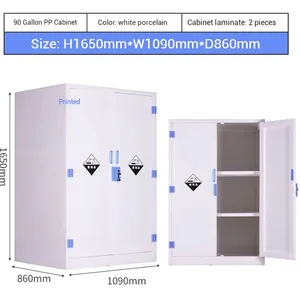
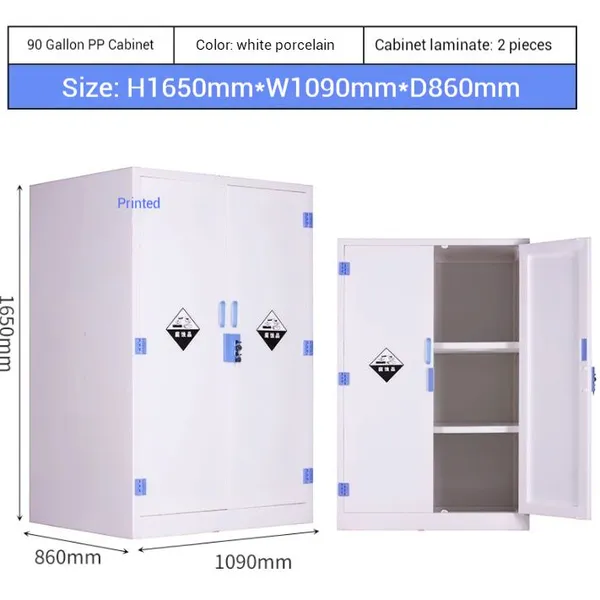
Luoyang Hengna Office Furniture Co., Ltd. has been in steel furniture for nine years, working directly with the production facilities that build our range. For dosing rooms the Hengna PP acid cabinet is built as follows — the 90-gallon configuration is the one most often specified where a site keeps full-size containers:
Material: polypropylene throughout — body, shelves, handles and hinges. No coated steel, nothing to perforate
Capacity: 90 gal / 340 L class, 1650 × 1090 × 860 mm, double door
Shelves: two height-adjustable shelves, extractable for cleaning, with a raised lip on all four sides to hold a small spill
Hinges and handles: moulded PP, so a damp room cannot make them stiff or drop the door
Ventilation: louvred ports, connectable to the room exhaust
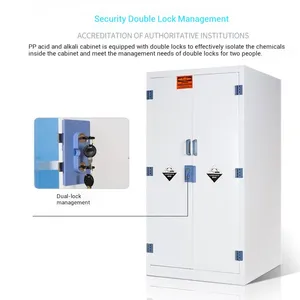
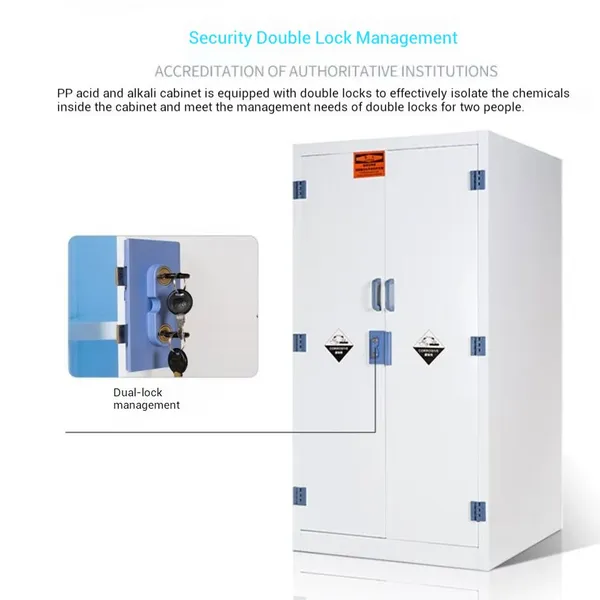
Locking: twin independent locks, keys not interchangeable — two people to open
Marking: corrosive hazard label on the door
Delivery: welded and fully assembled
Certification: CE
Warranty: 1 year
Colour: porcelain white, consistent across the range
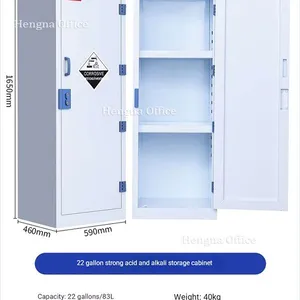
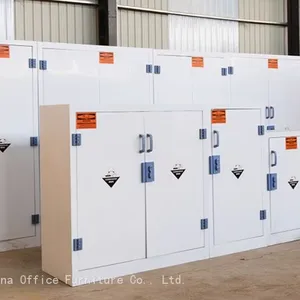
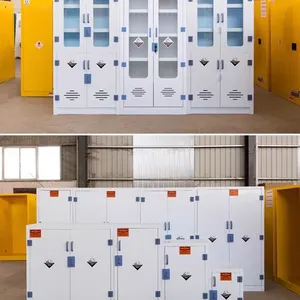
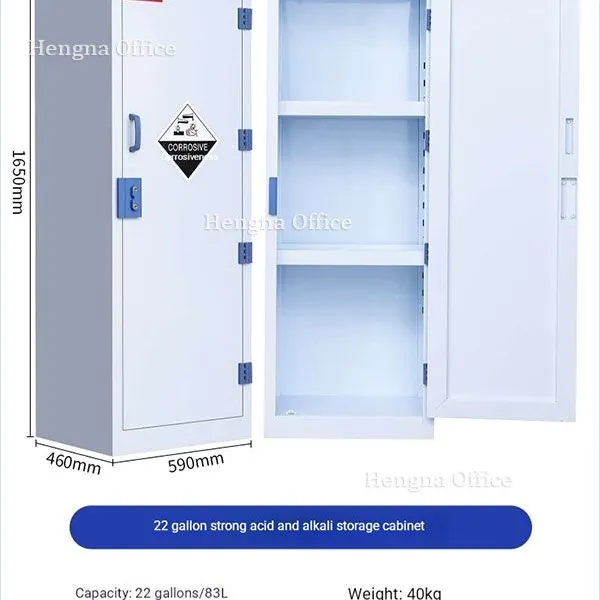
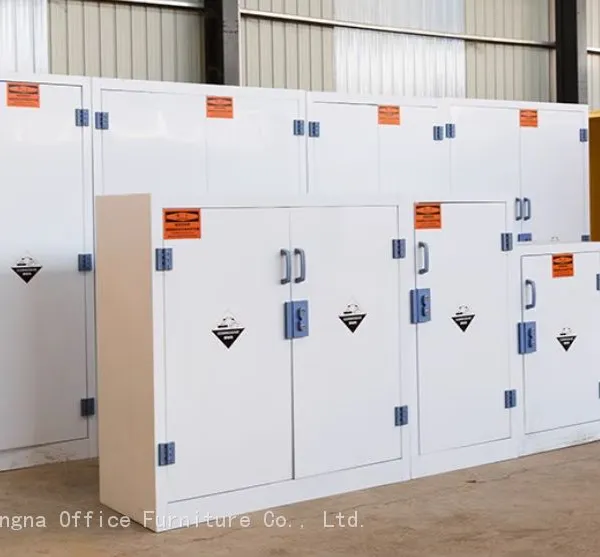
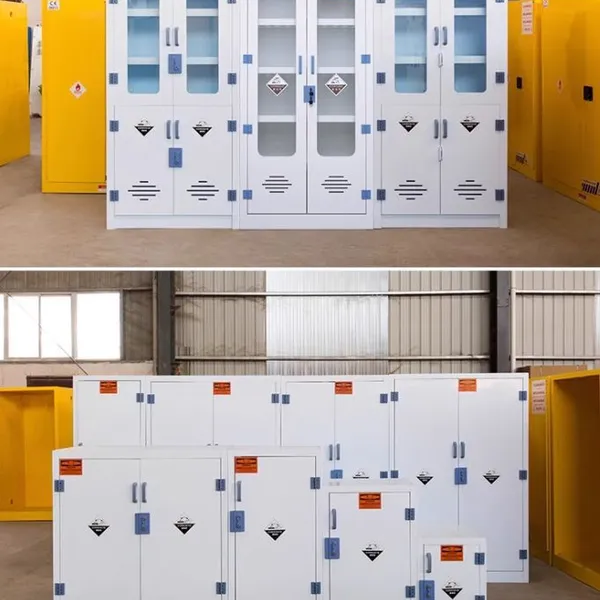
Also available in the same range, on the same construction: 4, 12, 15, 22 and 60-gallon single and double door units for smaller dosing points, and a 200 L cabinet series with glass or louvred door options where the site wants to read the stock level without opening the door.
The smaller sizes matter more than they look. A satellite dosing point with two 25 L containers does not need a 90-gallon cabinet — it needs a small PP cabinet that keeps the oxidiser out of the acid's reach. Most sites end up with a mix of sizes rather than one unit repeated.
The Details That Decide Whether It Works
Four things, and they are all cheap at the ordering stage and awkward to add later.
Ventilation that actually connects. A louvred port only helps if it is ducted into the room extract. An unconnected port on a cabinet full of hypochlorite keeps vapour inside.
Two locks, not one. Dosing chemicals are a safety and an inventory item. Independent locks let the operations lead hold one key and the EHS lead hold the other, so no single person opens the oxidiser cabinet alone.
A spill lip on every shelf. Not just the bottom of the cabinet. Most spills start with a container on the top shelf, and what runs down from there is what reaches the shelf below.
Labels on the cabinet, not just the drums. The person who needs to know which cabinet holds the hypochlorite is often not the person who filled it.
What This Cabinet Is Not For
Being straight about the limits, because PP is not a universal answer.
Flammable liquids. Polypropylene is not fire-rated. Flammable solvents belong in a fire-rated cabinet, not this one.
Hydrofluoric acid. HF attacks glass and needs specific handling; confirm material compatibility and containment against your SDS before storing it in any plastic cabinet.
Fuming nitric acid and some strong oxidisers. Compatibility with polypropylene varies with concentration and temperature. Check the SDS, and ask us — we would rather answer the question than have you find out.
High-temperature locations. Keep the cabinet out of direct sun and away from heat sources; a dosing room next to a boiler room is the wrong place.
Outdoor or unroofed installation. This is an indoor cabinet.
Storing incompatible classes together. Repeating it because it is the whole point: buy more cabinets, not a bigger one.
FAQ
What is the MOQ?
One unit for a sample. Site and distributor orders are quoted from the container up.
How does pricing work?
We do not publish prices — capacity mix and freight vary too much. Send the chemical classes and the quantities and you have a quote within 24 hours.
FOB, CIF or something else?
All three, plus EXW. Give us the destination port and we quote the terms that suit you.
Warranty?
1 year. Non-user-damage faults are covered with replacement parts.
After-sales?
Spare parts shipped from our side. For site and distributor accounts we agree a spares list up front — hinges, locks, shelf brackets — so a single failure does not take a cabinet out of service.
Can we put our own brand on it?
Yes. Silk-screen logo, custom packaging, and custom manuals under your brand. Shelf quantity and door configuration are also configurable.
Lead time?
Standard configuration 7–15 days. Custom layout or branding 20–30 days.
How is it packed?
Moisture film, corner protectors, and hardware bagged separately, with foam between cabinets in a multi-unit shipment. Polypropylene cabinets ship assembled.
Does it need assembly on arrival?
No. Set it on level floor, connect the vent port if you have one, and load it.
Can we mix sizes in one order?
Yes, and most dosing rooms do — a large cabinet for the main store and small ones for satellite dosing points. Send your chemical list and we will propose a split.
Next Step
Send us your chemical list and the number of dosing points. We will tell you how many cabinets the list actually requires, and you will have a quote within 24 hours — we supply dosing rooms and chemical stores across Southeast Asia, the Middle East and West Africa.

Send Inquiry to This Supplier



You May Also Like
-
Professional PP Laboratory Medicine Cabinet- LTC545 |Double Lock &Leak-proof Design Safe Anti-Corrosive Chemical Storage for Strong AcidUS$ 200 - 600MOQ: 5 Combos
-
High Quality Polypropylene Corrosive Storage Cabinet-LCT635| Adjustable Laminates With Internal Hollow Design for Lab Reagent Safe StorageUS$ 200 - 600MOQ: 5 Combos
-
Heavy Duty 1800mm PP Medicine Cabinet-LCT209 |Ventilation Hole&Adjustable Shelves- 200L Capacity Acid & Base Resistant Storage for Mining LaboratoriesUS$ 200 - 600MOQ: 5 Combos
-
White PP Cabinet-LCT546| & Glass Door for Pharmacy and Hospital Storage-Customized Laboratory Furniture for High School Science LabsUS$ 200 - 600MOQ: 5 Combos
-
Durable Plastic Chemical Storage Cabinet-LCT634-Fully PP Materials With Double Lock for Food Safety Testing Labs- OEM/ODM SupportedUS$ 200 - 600MOQ: 5 Combos
-
Hot Sale 900mm Width PP Medicine Cupboard-LCT426 With Adjustable Laminates&Leak-Proof Tray for University Lab- China Factory HengnaUS$ 200 - 600MOQ: 5 Combos
-
Rust-proof PP Storage Locker-LCT326 |Double Lock &Anti-corrosion Marking for Semiconductor Cleanroom and Biotech ResearchUS$ 200 - 600MOQ: 5 Combos
-
Factory Price Laboratory Reagent Storage Cabinet- LCVT937 |All PP Material ( Handle、hinge Ventilation Hole) for Corrosive Chemicals Safe StorageUS$ 200 - 600MOQ: 5 Combos
-
Modern Design Lab Glassware Storage Cabinet-LCT209 | PP Cabinet With Touch Ball Design Door for Wastewater Treatment Plants- OEM/ODM SupportedUS$ 200 - 600MOQ: 5 Combos
-
Global Standard PP Medical Cabinet-LCT257 With Double Door and 3 Adjustable Shelves for Petrochemical Research StationsUS$ 200 - 600MOQ: 5 Combos

