


 Contact Platform Support
 Help Center
School Chemistry Lab Bench – Steel Cabinets | Reagent Racks & Sink Units | Student-Proof
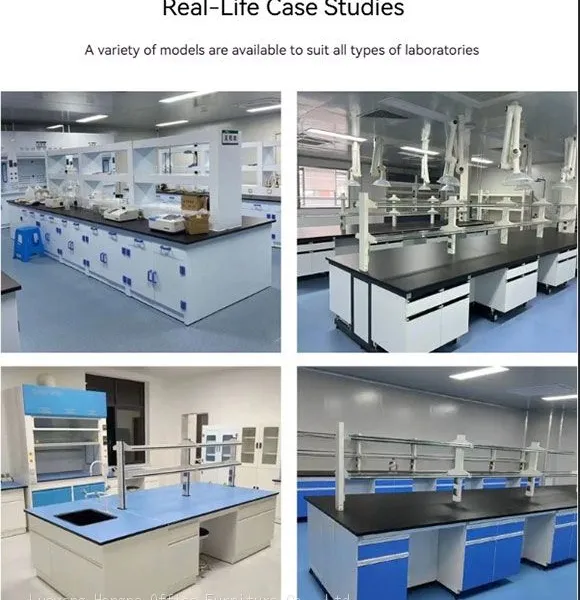
Product Spotlights





Related Products
-
 Custom Lab Bench Manufacturer — OEM Steel-Wood Workbenches With CE CertificateUS$ 200 - 800MOQ: 3 Sets
 -
Chemical Resistant Lab Bench — 19mm Phenolic Resin Top & Cold-Rolled Steel FrameUS$ 200 - 800MOQ: 3 Sets
-
Paraffin Block Storage Cabinet — Indexed Drawers: Know Which Block Is Where Before You Open the DrawerUS$ 80 - 300MOQ: 5 Combos
-
Paraffin Block Storage Cabinet — Indexed Drawers: Know Which Block Is Where Before You Open the DrawerUS$ 80 - 300MOQ: 5 Combos
-
Modular Lab Bench System – Steel-Wood KD Units | Custom Widths to 4500mm | Fits Any RoomUS$ 200 - 800MOQ: 3 Sets
School Chemistry Lab Bench – Steel Cabinets | Reagent Racks & Sink Units | Student-Proof
The school lab bench has to survive three things
Budget cuts, student abuse, and chemical spills. In that order.
A school buying a chemistry lab bench is not looking for the best bench in the world. They are looking for one that will not fall apart when a sixteen-year-old leans on it, will not corrode when someone spills hydrochloric acid on the surface, and will not require replacement in five years when the budget committee refuses to fund another round of furniture.
The problem is that most lab furniture sold to schools is built to look like a lab bench in a catalog. It arrives, it looks clean and professional, and it starts degrading within two years — the phenolic surface cracks, the steel frame rusts, and the drawers stop closing. By the time the lab needs new furniture, the school has already spent more on repairs than the original bench cost.
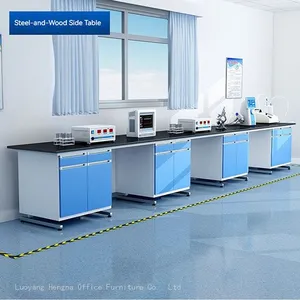
This bench is built for the school that does not want to buy furniture twice. It is a steel-wood chemistry lab bench with a phenolic resin worktop, steel cabinets, reagent racks, and sink units — designed for the school environment where durability, safety, and cost are non-negotiable.
The worktop that actually handles acid
In a school chemistry lab, spills are not an exception. They are a daily event. The worktop has to handle sulfuric acid, hydrochloric acid, sodium hydroxide, ethanol, and whatever else a student mixes without asking permission first.
This bench uses a solid phenolic resin worktop — not particleboard with a phenolic veneer, not laminate, not wood with a chemical-resistant coating. The phenolic resin is solid throughout, meaning that even if the surface is scratched, chipped, or gouged, the material underneath is the same chemical-resistant resin. There is no substrate to absorb chemicals, no coating to peel off, and no particleboard core to swell when liquid seeps through.
The standard thickness is 12.7mm, with 16mm and 19mm available for labs that handle heavier chemical loads. The worktop is rated for daily exposure to acids, bases, and organic solvents — not in theory, but in the kind of repeated exposure that happens when forty students are doing experiments at the same time.
For schools that need a budget-friendly option, the bench is also available with an 18mm E1-grade particleboard top with PVC edge banding. It does not have the same chemical resistance as phenolic resin, but it handles the occasional spill and it costs less. The choice depends on the lab — a chemistry lab needs phenolic; a biology lab can work with E1-grade melamine.
Steel cabinets that do not rust
The cabinet body is cold-rolled steel, powder-coated with an epoxy finish. This is not paint. It is a coating that is electrostatically applied and cured at high temperature, creating a hard shell that resists scratches, chips, and corrosion.
In a school environment, the cabinets get kicked, bumped with chairs, scraped with equipment, and wiped down with disinfectant daily. The epoxy powder coat holds up to all of it. It does not peel like paint, does not chip like laminate, and does not absorb moisture like wood.
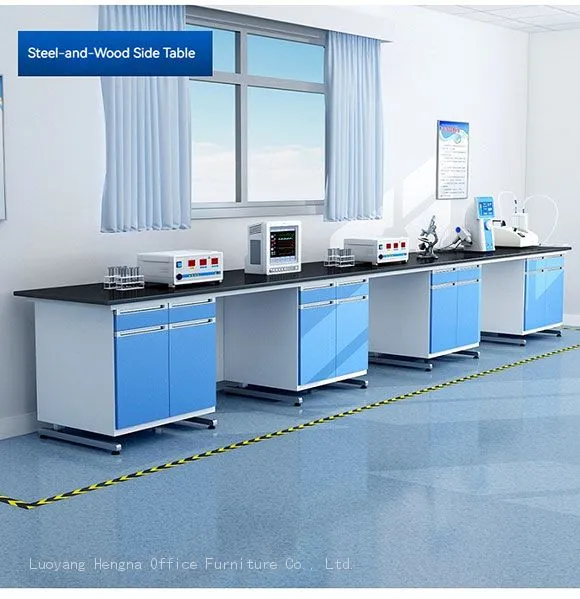
The steel thickness is 1.0mm for standard school use, with 1.2mm and 1.5mm available for heavier applications. The cabinet structure is rigid — it does not wobble, does not lean, and does not need to be anchored to the wall to stay upright. A row of these benches in a classroom stays straight and aligned, even with students pushing in chairs and pulling open drawers.
Reagent racks: the feature that saves the worktop
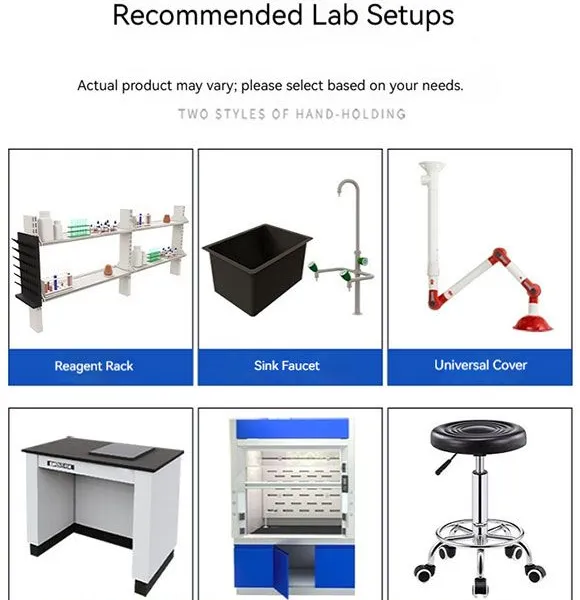
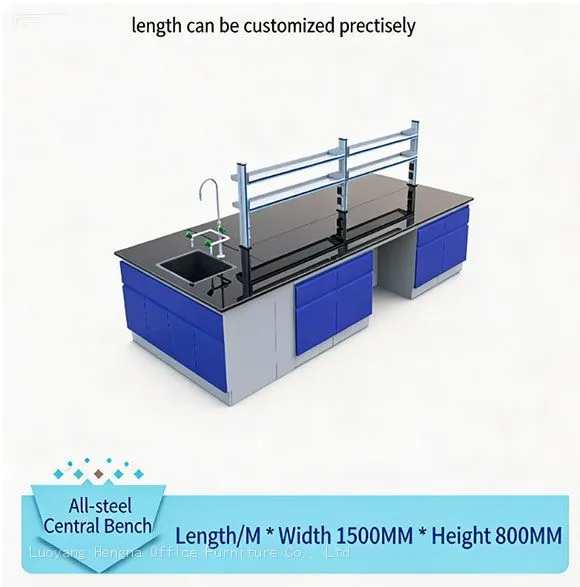
A reagent rack is a raised shelf that sits on top of the worktop, holding bottles of chemicals at the back of the bench. Without a reagent rack, students put bottles directly on the worktop — blocking space, risking spills, and knocking bottles over.
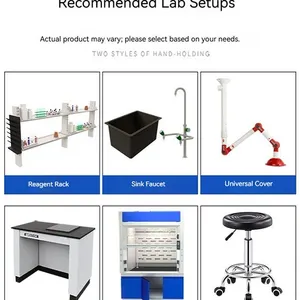
This bench includes reagent racks as standard. The rack is made of the same cold-rolled steel as the cabinets, powder-coated for corrosion resistance, and positioned at a height that keeps bottles visible and accessible without blocking the work area. The rack has slots for test tube holders and small containers, so the bench is not just a work surface — it is a complete experiment station.
For labs that do not need reagent racks, they can be removed without modifying the bench. The bench works as a flat surface when the racks are off, and as a fully equipped experiment station when the racks are on. The modularity is built in, not optional.
Sink units: built into the bench, not bolted on
A school chemistry lab needs water. Experiments require rinsing, cleaning, and disposal of liquid waste. Most lab sinks are afterthought additions — a plumber cuts a hole in the worktop, bolts on a sink, and seals it with silicone that leaks within a year.
This bench has sink units designed as part of the bench system. The sink sits flush with the worktop, sealed with an epoxy compound that is chemically resistant. The drain runs through the cabinet base, with a P-trap hidden inside. The result is a sink that looks like it belongs on the bench — because it was designed to be there, not added later.
The sink unit includes a water tap, a waste trap, and a connection point for the water supply. For schools that need hot and cold water, the tap is dual-handle. For schools that need filtered water, the tap can be fitted with a filtration adapter. The configuration depends on the lab’s plumbing — the bench accommodates whatever is there.
Configuration: build the bench your lab needs
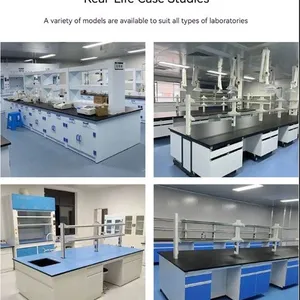
The bench is modular. It comes in units from 300mm to 1000mm wide, and they can be combined to fit any room — from a small prep room to a full-size classroom.
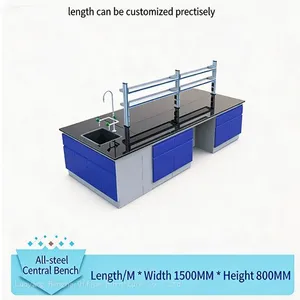
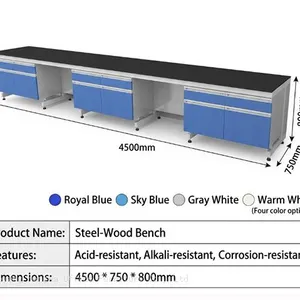
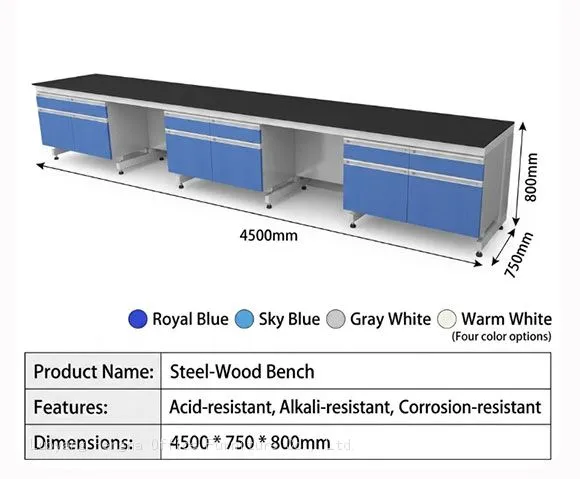
A standard school chemistry lab bench is 3000mm to 4500mm long, but the bench does not have to be one piece. It can be built from multiple units: a 1000mm base cabinet, a 600mm sink unit, a 400mm drawer unit, and another 1000mm base cabinet. The modular design means the bench fits the room, not the other way around.
The bench is available in three height options: 800mm, 850mm, and 900mm. The 800mm height is standard for student labs — low enough for students to work comfortably, high enough for instructors to see across the bench. The 850mm and 900mm options are for standing-height work in university research labs.
The depth is 750mm for standard use, giving enough work surface for experiments while leaving room for the reagent rack behind. For labs that need more depth, 900mm is available — but for most school chemistry labs, 750mm is the right balance between workspace and room flow.
The spec at a glance
| Item | Standard | Available Options |
|---|---|---|
| Worktop | 12.7mm solid phenolic resin | 16mm, 19mm phenolic; epoxy resin; E1 melamine |
| Cabinet body | 1.0mm cold-rolled steel + epoxy powder coat | 1.2mm, 1.5mm; galvanized steel; 304/316 stainless |
| Width | Modular units: 300mm to 1000mm | Combined to 4500mm+ |
| Depth | 750mm | 900mm |
| Height | 800mm | 850mm, 900mm |
| Reagent rack | Steel, powder-coated, with test tube slots | Removable, optional |
| Sink unit | Epoxy-sealed, flush-mount | Dual-handle tap, filtration adapter |
| Assembly | KD knock-down, or fully assembled | Tool-free snap-fit panels |
| Colors | Cabinet: light grey; kickboard: dark grey | Door panels: custom colors (steel-wood) |
Who buys this bench
School procurement departments in Southeast Asia, Middle East, and Africa — where STEM education budgets are growing, labs are being built for the first time, and the furniture has to last ten years on a single purchase.
University chemistry departments that need workbench solutions for teaching labs — where the bench must handle student experiments, instructor demonstrations, and occasional cleanup of spills that nobody reports.
Laboratory supply distributors who need a reliable bench that they can stock in quantity, sell with confidence, and support with replacement parts when a school calls to order a new drawer handle.
Government tenders for school and university laboratory equipment — where the bench has to meet a specification, pass an inspection, and be delivered on a schedule that does not allow for delays.
KD advantage: more benches per container
The bench ships as knock-down units — flat-packed, with hardware bagged and glass components packed separately. This means more units per container, lower freight costs per bench, and the ability to deliver to schools that are under construction, where loading docks do not exist yet.
The assembly is straightforward: base panels first, then uprights, then worktop, then reagent rack and sink. The panels are pre-drilled, the fasteners are engineered, and the assembly sequence is logical. A team of two can assemble a full bench in under thirty minutes.
For distributors who store in warehouse before selling, the flat-pack design means more units on the shelf, less space wasted, and faster turnover. The bench stores flat and ships flat — no wasted air in the carton.
Built for export — factory-direct from Luoyang
This bench is made by a steel furniture factory in Luoyang, China, and it is exported to schools, universities, and labs worldwide:
Factory-direct pricing, with drawings and packaging spec included in every quote
KD design for economical shipping and easy on-site assembly
OEM and ODM welcome — your logo, your colors, your configuration
Product complies with E1 formaldehyde standards for indoor furniture
Standard and custom colors — match your school’s identity or your country’s procurement spec
Whether you are a school procurement officer outfitting a new lab, a distributor supplying laboratory furniture, or a project contractor fitting out a school renovation, the process is the same: confirm the spec, check the sample, receive the container.
Questions school buyers ask
What is a school chemistry lab bench?
A school chemistry lab bench is a steel-wood workbench designed for student experiments. It has a chemical-resistant worktop (typically phenolic resin), steel cabinets for storage, a reagent rack for holding chemicals, and a built-in sink unit. It is designed to handle daily use by students and regular exposure to acids, bases, and solvents.
What material is the worktop?
The standard worktop is solid phenolic resin — a material that resists chemicals, heat, and impact. It is available in 12.7mm, 16mm, and 19mm thicknesses. For labs that do not need full chemical resistance, an 18mm E1-grade melamine top with PVC edge banding is also available.
Can the bench be customized to fit our room?
Yes. The bench is modular, with units ranging from 300mm to 1000mm wide. These units can be combined to fit any room — from a small prep room to a full-size classroom. The standard depth is 750mm, and the standard height is 800mm, with taller options available.
Do we need reagent racks?
If the lab conducts chemistry experiments, yes. Reagent racks keep chemical bottles organized and accessible, prevent spills on the worktop, and create a complete experiment station. The racks can be removed if the bench is used for non-chemistry purposes.
How long does assembly take?
The bench ships as knock-down units and assembles on site. A team of two can assemble a full bench in under thirty minutes. The panels are pre-drilled, and the fasteners are engineered — no drilling, no guessing, no leftover parts.
What about after-sales support?
We provide replacement parts for all bench components — drawers, hinges, rails, sink units, reagent racks. The parts are standardized and available for order at any time. For schools that need long-term support, we can set up a spare parts agreement.
The bench that outlasts the funding cycle
A school chemistry lab bench is not a purchase for this year. It is a purchase for the next ten years — the bench that sits in the lab while three cohorts of students graduate, while teachers change, while the curriculum evolves. This bench was built for that timeline. The steel does not rust, the phenolic does not corrode, and the modular design means that when the lab needs to change, the bench changes with it.
Request a quote with your configuration, your quantity, and your port. We will confirm the spec, the colors, and the freight in one reply.

Send Inquiry to This Supplier



You May Also Like
-
Acid Resistant Lab Bench – PP or Phenolic Worktop | for Mining Assay Labs | Ships FlatUS$ 200 - 800MOQ: 3 Sets
-
Laboratory Wax Block Cabinet QST-LK53 Microscope Slides 72 Drawers CabinetNegotiableMOQ: 10 Pieces
-
11000 Tissue Blocks Cold-roll Steel Paraffin Block Cabinet Lab - Grade Wax Block CabinetNegotiableMOQ: 10 Pieces
-
Microscope Slides Slide Drying Cabinet With Numbered Labels Compact Wax Block CabinetNegotiableMOQ: 10 Pieces
-
Pathological Ection Cabinet JTGZ062 Wax Block Cabinet for LaboratoryNegotiableMOQ: 10 Pieces
-
Paraffin Wax Storage Cabinet QST 068 Pathology Microscope Slide CabinetNegotiableMOQ: 10 Pieces
-
Customized Oem Histology Wax Block Storage Cabinets for Medical Labs FactoryNegotiableMOQ: 10 Pieces
-
Custom Paraffin Block Storage Cabinet for Histology Laboratories – Factory Direct From Hengna FurnitureNegotiableMOQ: 10 Pieces
-
OEM & ODM Paraffin Block Storage Cabinets for Histology Laboratories – Made in China by Luoyang Hengna OfficeNegotiableMOQ: 10 Pieces
-
White Stackable Pathology Wax Block Storage Drawers for Labs Near London-Hengna OfficeNegotiableMOQ: 10 Pieces

