


 Contact Platform Support
 Help Center
Industrial Workbench WB-M916 — Tool Cabinet, Drawers & Pegboard for Maintenance Teams




Product Spotlights




Related Products
-
 Cold Rolled Steel Workbench WB-M930 — Factory Direct for Malaysian WorkshopsUS$ 60 - 220MOQ: 5 Combos
-
Hengna Industrial Production Work Table|Heavy Duty Solid Wood Workbench for WorkshopUS$ 300 - 800MOQ: 2 Cases
-
Commercial Workbench Supplier |Multi Metal Work Bench With Drawers OMDUS$ 300 - 800MOQ: 2 Cases
-
Multi Metal Work Benches Electrical Workshop Workbench|US$ 300 - 800MOQ: 2 Cases
-
Heavy Duty Workbench for Garage & Workshop | Industrial Strength WorkbenchesUS$ 200 - 600MOQ: 5 Sets
Industrial Workbench WB-M916 — Tool Cabinet, Drawers & Pegboard for Maintenance Teams
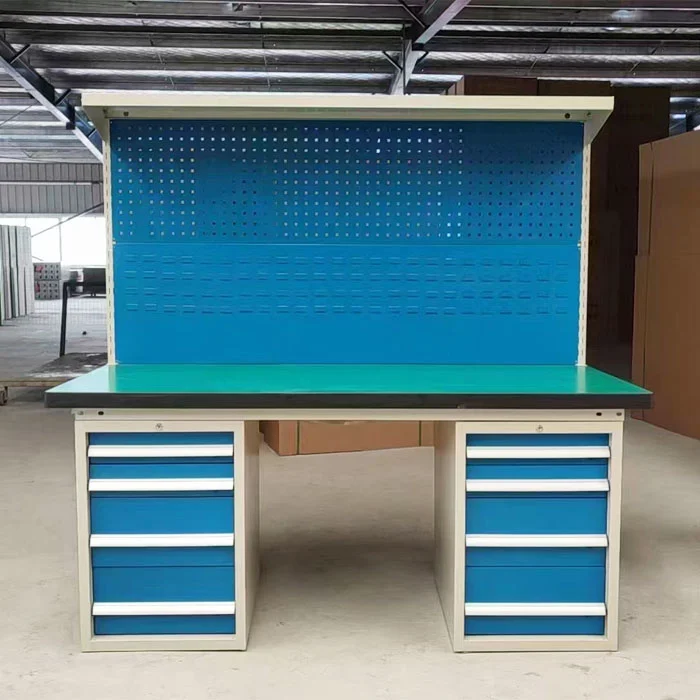
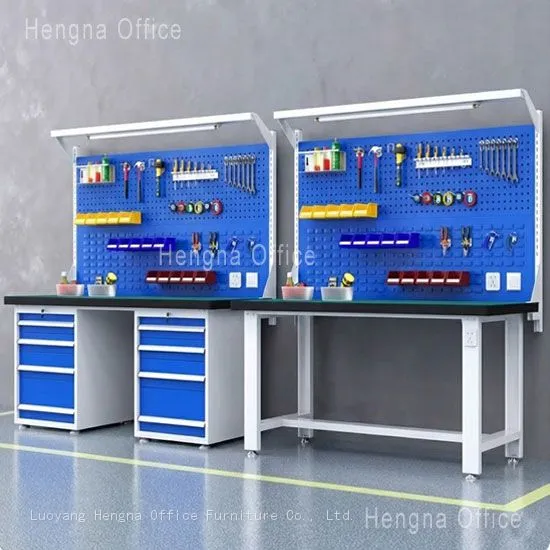
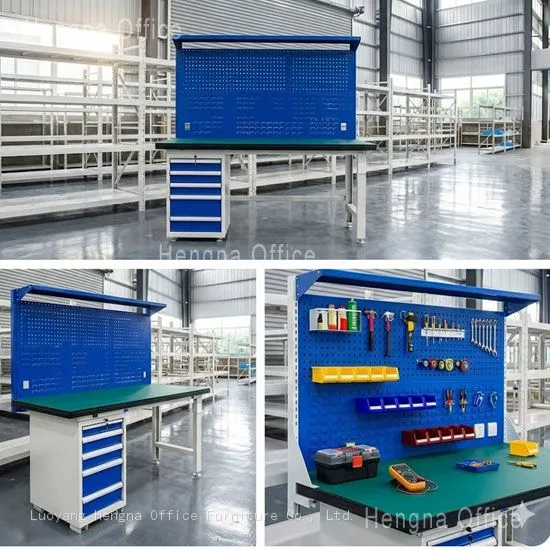
The most expensive tool in a maintenance bay is the one nobody can find. A tech walks, searches three drawers, asks two colleagues, loses fifteen minutes — on a good shift, that happens four times. The WB-M916 is an industrial workbench built to end that routine: drawers for the small stuff, a door cabinet for the bulk, a full-width pegboard for the tools that should never leave sight. Everything within one step of the worktop. Grab, fix, return — that is the whole system.
The Real Cost of a Messy Maintenance Bay
Downtime is not only broken machines. It is also the quiet tax a disorganized bench charges every hour of every shift: the spanner that migrated to another bay, the caliper nobody calibrated because nobody knew where it was, the second set of pliers bought because returning the first set was more trouble than replacing them. Multiply that by techs, shifts and weeks, and a messy bench becomes a line item.
A bench is the cheapest part of the fix. Organization itself costs nothing — but it only holds if every category of tool has a permanent, visible home. That is what this bench is: a housing system with a worktop on it.
What Goes Where: Pegboard, Drawers, Door Cabinet
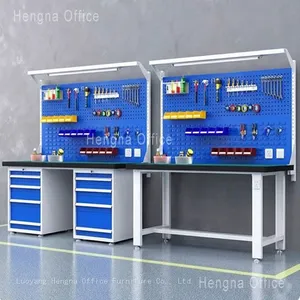
Pegboard — for the tools a tech touches every hour. A square-hole panel runs the full width of the back, 450 mm low or 1,000 mm high, standard pitch, so common hooks, bin rails and holders clip straight on. Wrenches, pliers, screwdrivers and hex keys hang in plain sight. The point is not storage; it is the glance — one look tells a tech what is there and what walked off.
Drawers — for anything measured in microns. Calipers, micrometers, feeler gauges, torque bits and job kits belong in drawers, not on hooks: out of the dust, out of the light, flat and protected. Measure tools live in drawers; that rule alone prevents half the “it was fine yesterday” conversations.
Door cabinet — for anything measured in boxes. Lubricants, spare belts, gasket sets, boxes of fittings and the consumables that breed loose clutter go behind the door, away from grinding dust and off the worktop.
The rule of thumb writes itself: used hourly, it hangs; measured in microns, it draws; bought by the box, it goes in the cabinet.
Six Base Configurations, One Bay Plan
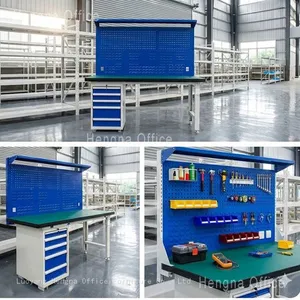
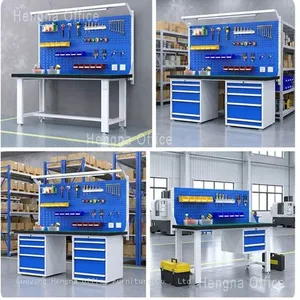
The WB-M916 frame takes six lower layouts: an open single table, a suspended 2-drawer, a flat 3-drawer, a fixed 4-drawer, dual 4-drawer cabinets, and a 4-drawer-plus-door combination. Widths run 1200, 1500, 1800 and 2100 mm on a 750 mm deep top.
One tech covering a line: 1200–1500 mm with the fixed 4-drawer base. Two techs on split shifts: 1800–2100 mm with dual 4-drawer cabinets, so each side owns its drawers and nobody shares blame. Shops that also run the WB-M908 fitting bench will recognize the frame family — same steel, same finish, same footprint logic, so mixed-trade bays still look like one shop instead of a flea market.
How Shift Teams Keep a Bench Fast — 30 Days In
Buying the bench is day one. The habit is what pays, and the crews who run tight maintenance bays all do the same three things:
Label like it is not optional. Drawer fronts get content labels; the pegboard gets tool outlines in tape or paint. When a spanner goes missing, the empty silhouette says so from across the bay — no audit meeting required.
Colour-code by job. Blue bins for electrical, red for hydraulics, yellow for consumables — colour-coded parts bins are optional on this bench, and worth ordering. A tech borrowed from another line finds the right drawer without asking anyone.
Five minutes at shift end. Reset the board, close the drawers, leave a one-line handover: what is out, what is broken, what is on order. Crews that skip this step are back to treasure hunts within a month. This is a 5S program in miniature — a place for everything, the place is visible, and the visibility does the enforcing.
Power, Light and a Level Foot
The pegboard carries a five-hole socket and a dedicated light switch; the suspended lamp bracket slides up or down to kill shadows at the worktop. Leveling feet take care of uneven floors so the drawer rack stays square and doors close flush — a small detail that becomes daily friction if ignored.
WB-M916 Specifications at a Glance
| Item | Specification |
|---|---|
| Frame | Full-welded cold-rolled steel (SPCC), integral bent panels |
| Finish | Electrostatic powder coating, industrial blue / grey |
| Widths | 1200 / 1500 / 1800 / 2100 mm (custom on request) |
| Depth | 750 mm |
| Height | ≈800 mm bench; up to ≈2000 mm with pegboard |
| Pegboard | 450 mm or 1000 mm, square-hole, standard pitch |
| Base options | Single table / suspended 2-drawer / flat 3-drawer / fixed 4-drawer / dual 4-drawer / 4-drawer + door |
| Tabletops | Steel plate / composite anti-static / 201–304 stainless / solid wood |
| Power | 5-hole socket + light switch on pegboard, adjustable lamp bracket |
| Feet | Screw-adjust steel legs, anti-slip pads |
| Packing | Knock-down, flat pack |
| Service | OEM / ODM, factory direct — Luoyang Hengna |
Maintenance Workbench FAQ
How many drawers does a maintenance bench actually need? Fewer than most buyers think. It is about assigning homes, not maximizing count: a 4-drawer base plus door cabinet covers most single-tech bays. Dual 4-drawer is for two techs, not for one tech with more tools.
450 mm or 1000 mm pegboard — which one? 1000 mm if hand tools are the daily job — more hanging area pays for itself in the first week. 450 mm suits tight bays, low ceilings, or benches that sit under shelving. When in doubt, go tall.
Drawers or door cabinet — which is better? Both, for different loads. Drawers organize small tools; doors hide bulk. If you can only pick one layout, the 4-drawer-plus-door combination beats either option alone — that is why it is the maintenance default.
Can two technicians share one bench? Yes, with the dual 4-drawer configuration and a divided pegboard — one zone each, assigned by name. Sharing drawers is where tool accountability goes to die; splitting the bay keeps it alive.
How do I stop the pegboard turning into a dump zone? Outlines, a one-in-one-out rule, and the end-of-shift reset. If a tool has no outline, it does not live on the board — it goes in a drawer or it leaves the bay.
Order the Bench, Keep the System
Send the headcount, the tool list and the bay size — the factory replies with a configuration and a quote. Stock frames ship flat-packed; custom widths, colours and drawer layouts are quoted separately.

Send Inquiry to This Supplier



You May Also Like
-
Modular Workbench With Pegboard for Tool OrganizationUS$ 600 - 1200MOQ: 5 Combos
-
Heavy-Duty Automotive Workbench - 1000 Lbs Capacity Steel Workbench for Car Repair ShopsUS$ 200 - 600MOQ: 5 Sets
-
Industrial Steel Workbench for Manufacturing - Heavy-Duty Assembly Workstation With StorageUS$ 200 - 600MOQ: 5 Sets
-
Hengna Welding Workbench Heavy-Duty - Fire-Resistant Steel Workbench for Metal FabricationUS$ 200 - 600MOQ: 5 Sets
-
Hengna Professional Woodworking Workbench - Heavy-Duty Bench With Vise for Carpenter ShopsUS$ 200 - 600MOQ: 5 Sets
-
Portable Heavy Workbench for Construction - Folding Steel Workbench for Job Sites SupplierUS$ 200 - 600MOQ: 5 Sets
-
Hengna Maintenance Workbench Heavy-Duty - Industrial Repair Bench With Tool Storage DistributorUS$ 200 - 600MOQ: 5 Sets
-
Hengna Educational Heavy Workbench - Student Steel Workbench for Vocational Training CentersUS$ 200 - 600MOQ: 5 Sets
-
Hengna Supplier Home Garage Blue Heavy Workbench - Professional Steel Workbench for DIY ProjectsUS$ 200 - 600MOQ: 5 Sets
-
Hengna Aviation Maintenance Workbench - Precision Heavy-Duty Bench for Aircraft RepairUS$ 200 - 600MOQ: 5 Sets

